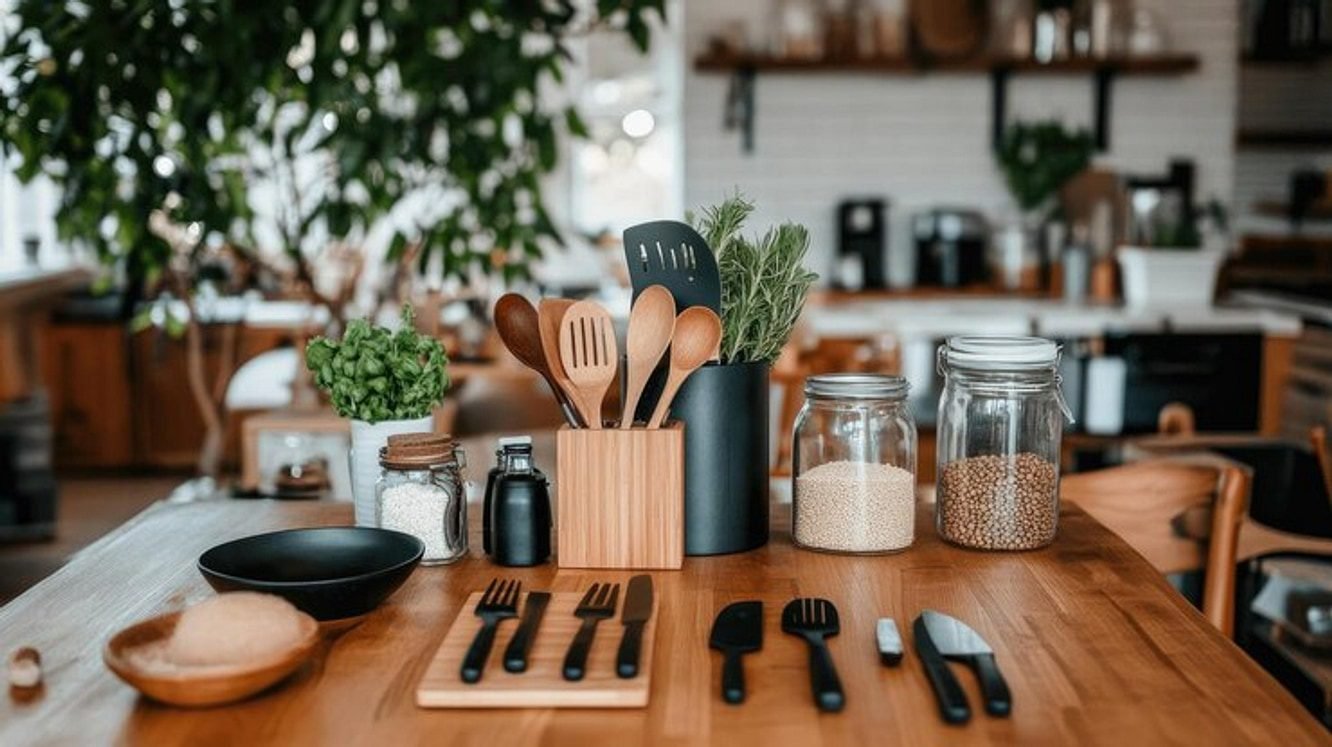
Cooking in a minimalist kitchen doesn’t mean cooking with less joy. Instead, it means only stocking the essentials that have proven their use to you time and time again with dependable performance and easy storage so you can cook without clutter or hassle.
What Does Minimalist Kitchen Even Mean?
Preparing food on an empty countertop is about as minimalist as a kitchen can get. But that doesn’t work for most homes or cooks. A minimalist kitchen comes down to purging duplicates, unused gadgets, and anything that creates visual and mental clutter. But you never want to purge so much that you don’t have the tools you use to cook real meals several times each week.
Think of minimalist cooking as streamlining your kitchen. Instead of browsing hundreds of jars, bowls, and baking sheets when you cook, everything you own has a purpose. Cooking takes less time. Cleaning up takes less time. Grocery shopping and meal planning takes less time too, because you know exactly what your kitchen can handle.
Minimalist Kitchen Essentials #1: The Cookware: The Items You Use Most
Cookware is the heart of your kitchen inventory, and also where most kitchens run into problems. Pans are easy to buy but difficult to store when you have too many. For breakfast, sautéing, simmering, and roasting, most kitchens can get away with just a few well-made cooking pieces. Pick materials that you enjoy cooking with and choose versatility over novelty every time.
- A medium-sized skillet can fry eggs, vegetables, and small cuts of meat.
- A large stock pot is perfect for pasta, soup, grains, and boiling.
- You’ll likely still want a solid saucepan for sauces and smaller portions.
- Roasting pan or baking sheet for oven cooking and easy sheet pan dinners.
- And of course, if you have the room, a Dutch oven is never a bad idea either.
As long as each piece of cookware can be used to prepare multiple meals or quickly swapped with another pan, you should be in good shape. If you find yourself asking ‘why do I own this?’ when you look in the cabinet, it might be time to pass that item down to someone who can use it.
Minimalist Kitchen Essentials #2: Knives: What to Keep on Your Counter
When it comes to knives, minimalism should focus on how each knife feels in your hand. You want control and ease of use. You also want to be able to sharpen your knives without trouble. Forget about matching sets—your kitchen can function perfectly well with as few as three knives.
- A chef’s knife, paring knife, and serrated knife.
That’s right, just three. If you have room and enjoy cooking with them, you can expand beyond these three styles. But for most people, a chef’s knife does most of the cooking anyway. You use your chef’s knife to chop herbs, slice fruits and vegetables, and section proteins. You use your paring knife to peel vegetables and fruit or for other jobs where small knives will give you more control. For when you need to slice bread or cut more delicate fruits without damaging them, you reach for the serrated.
Minimalist Kitchen Essentials #3: Prep Tools: Don’t Go Crazy
Every kitchen needs some basic preparation tools, but this doesn’t have to be an area where your drawers explode with excess. Think about cooking activities that repeat each day. What do you use to chop? Measure? Mix? Scramble eggs? Drain pasta?
- Cutting boards will extend the life of your counters and improve your safety when chopping.
- Mixing bowls allow for prep, serving, and storage all in one helper.
- Measuring cups and spoons will keep you baking and measuring liquids properly.
- Keep a colander for straining pasta or rinsing veggies.
- Tongs are good for control when flipping food.
- And everyone should own a spatula of some sort.
If you can find sets that nest or stack together, you’ll be able to reach for these essentials every day without taking over all your storage.
Minimalist Kitchen Essentials #4: Gadgets: Avoid Duplicates at All Costs
The key to avoiding duplicates in any category is knowing where they occur. If you own something that can do the job with moderate success, does your kitchen need another version of the same tool?
Peelers, whisks, bottle openers, vegetable slicers, and even measuring tools are all commonly owned by many kitchens. Look around and you’ll likely find extras of some of these. Think about what you use on a weekly basis as opposed to what you may use seasonally or once a year. Things will become clearer once you edit out the gadgets that don’t get used very often.
Minimalist Kitchen Essentials #5: Small Appliances: Less Is More
Just like gadgets and kitchen tools, small appliances should be chosen wisely. If an appliance has too small of a benefit to you or your household, it’s probably not worth keeping around.
- Keep a toaster or toaster oven for quick breakfast meals and reheating leftovers.
- Blenders are great for smoothies, soups, or sauces.
- Kettles make boiling water for tea or other tasks quicker.
- Slow cookers are great for hands free meals that don’t feel minimalist.
- Consider a handheld immersion blender instead of a full sized blender.
You don’t need to own every small appliance in your kitchen. In fact, you shouldn’t. Look at the appliances you reach for daily and make sure those stay open for the ones you love.
Minimalist Kitchen Essentials #6: Storage: Keep Clutter at Bay
A well-organised kitchen will make your life easier and help you feel like a minimalist. Without thoughtful storage, it’s easy for your kitchen to become cluttered and buy things you already own. When thinking about storage, make sure you have places to put away:
- Cooking tools and utensils
- Dry goods
- Plates, bowls, and glasses
- Cleaning products and trash
Open storage and open shelves can look great in a minimalist kitchen. But if you struggle to keep your space tidy, closed cabinet doors and drawers may be a better option. You can even go as far as getting drawer dividers so that each essential has its own home, helping you avoid random piles building up in the one place you can’t afford to clutter: your drawers.
Minimalist Kitchen: Quality Over Quantity
It’s wonderful to be able to name every kitchen tool you own. But when you only own a few items, each one really needs to earn its place in your home. Items with better quality typically last longer, clean easier, and feel nicer to use. Don’t break the bank, but don’t buy cheap either.
Building your kitchen this way takes time. Start with good essentials that you know you’ll reach for daily, and build from there. A few reliable tools will always outperform a drawer full of poorly made gadgets that only serve to annoy you.
Minimalist Kitchen: Do What Works for You
Your kitchen doesn’t have to look like anyone else’s, and minimalism isn’t one-size-fits-all. Start small and build a kitchen that makes sense for how you like to cook. Take inventory of what you’re cooking each week. Make meals around what you own. When something breaks or you have obvious extra capacity, replace it.
Keep building your kitchen little by little, and soon you’ll have a minimalist space that works for you. Not anyone else. Your kitchen will function better, and you’ll spend less time cleaning and maintaining.