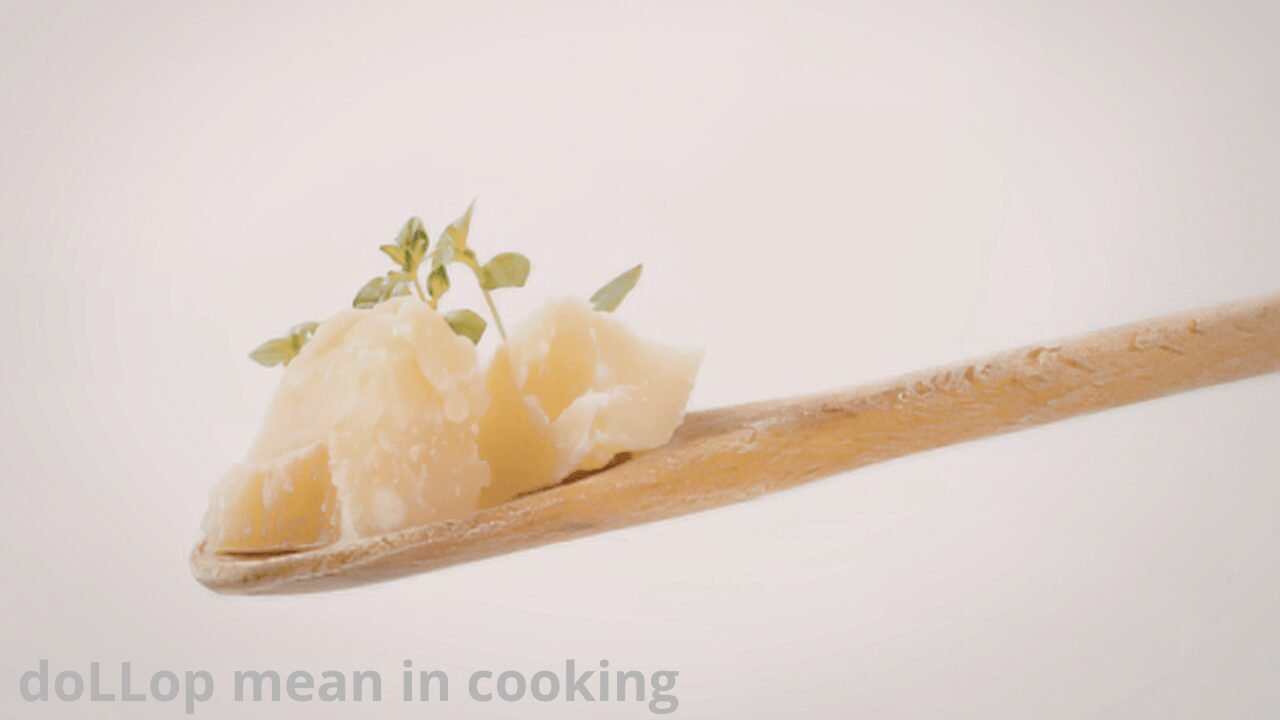
In cooking, a dollop is an informal amount of soft or thick food, usually added with a spoon. A spoonful of sour cream on chili or whipped cream beside a slice of pie is a familiar example.
The word describes a portion rather than an exact measurement. If a recipe says “add a dollop of yogurt,” it usually leaves you some freedom to choose an amount that suits the serving. Dictionaries likewise describe a dollop as an amount of soft food rather than a standardized measure. oxfordlearnersdictionaries.com
You may also see the word used as a verb: “dollop the cream over the fruit” means place spoonfuls of cream on top.
How Much Is a Dollop?
There is no fixed conversion from a dollop to teaspoons, tablespoons, milliliters, or grams.
Its size depends on the ingredient and the dish. A small spoonful of mustard beside a sandwich and a generous spoonful of whipped cream on a dessert can both be described as dollops.
If you are unsure, start with a modest amount. You can add more after checking how it balances with the food.
Do not assume that one dollop always equals one tablespoon. That may be a convenient portion for a particular dish, but it is not the definition of the word.
Common Examples
| Instruction | What to do |
|---|---|
| Add a dollop of sour cream to chili | Place a spoonful on top before serving |
| Serve with a dollop of whipped cream | Add a soft mound beside or over the dessert |
| Dollop yogurt over roasted vegetables | Place several spoonfuls across the vegetables |
| Add small dollops of jam to the batter | Distribute separate portions as the recipe directs |
A dollop usually suggests a mound or spoonful that holds together at least briefly. Thin liquids are more commonly described as a drizzle, splash, or pour.
The ingredient itself supplies the flavor. A dollop of plain yogurt is not inherently concentrated or intensely flavored simply because it is served this way.
How to Add a Dollop Neatly
You do not need a special tool.
- Take a spoonful of the ingredient.
- Hold the spoon close to the food or plate.
- Tilt it gently, using a second spoon to help release the mixture if needed.
- Leave it as a mound or spread it slightly, depending on the presentation you want.
Thick yogurt and sour cream usually hold their shape more readily than a loose sauce. Whipped cream needs gentler handling so you do not flatten it unnecessarily.
For a shared dish, distribute several smaller spoonfuls rather than placing everything in one large mound. This makes it easier to serve portions with a little topping each.
Should You Stir It In?
Follow the surrounding instruction.
“Top with a dollop” generally means leaving the addition visible on the surface. “Stir in a dollop” means mixing it through the dish.
For example, yogurt spooned onto soup can remain as a creamy contrast, while yogurt stirred into a dressing becomes part of the mixture.
The word alone does not tell you whether to mix, spread, swirl, or leave the ingredient untouched. The verb and the recipe context provide that information.
What Does Dollop Mean in Baking?
In baking, the word often describes how to distribute a mixture. You might dollop cheesecake filling over brownie batter or place spoonfuls of a topping across fruit.
Here, the recipe’s quantities still matter. If it specifies a measured amount of filling, use that amount and divide it as directed. “Dollop” explains the placement; it does not cancel the ingredient measurement.
Cookie dough and other portions that bake separately also need reasonably consistent sizing. Use the spoon size, scoop capacity, or weight specified in the recipe. King Arthur’s scoop comparison shows why matching the intended portion size matters for consistent results. King Arthur Baking
There is no universal dollop size for filling muffin cups, either. Follow the particular recipe’s yield and filling instructions.
When Should You Measure Instead?
Use a measuring spoon or kitchen scale when:
- The recipe provides an exact quantity.
- The ingredient affects the structure or moisture of a baked mixture.
- Portions need to cook consistently.
- You want to reproduce the same result next time.
For an optional topping, personal preference usually gives you more flexibility. A spoonful of sour cream added at the table is a different decision from the sour cream measured into a cake batter.
If a baking recipe gives only “a dollop” for an important ingredient and offers no other guidance, look for a quantity clarification rather than inventing a standard conversion.
A Simple Instruction with Room for Preference
“Dollop” is one of the more forgiving words you will encounter in a recipe. Most often, it asks you to add a spoonful of something soft without worrying about a perfectly measured or shaped portion.
Check whether the ingredient is a topping or part of the recipe’s structure. Measure when the recipe requires precision; otherwise, start small and adjust to your taste.
A slightly uneven spoonful of cream or yogurt does its job perfectly well. It does not need to look professionally styled to make the dish enjoyable.