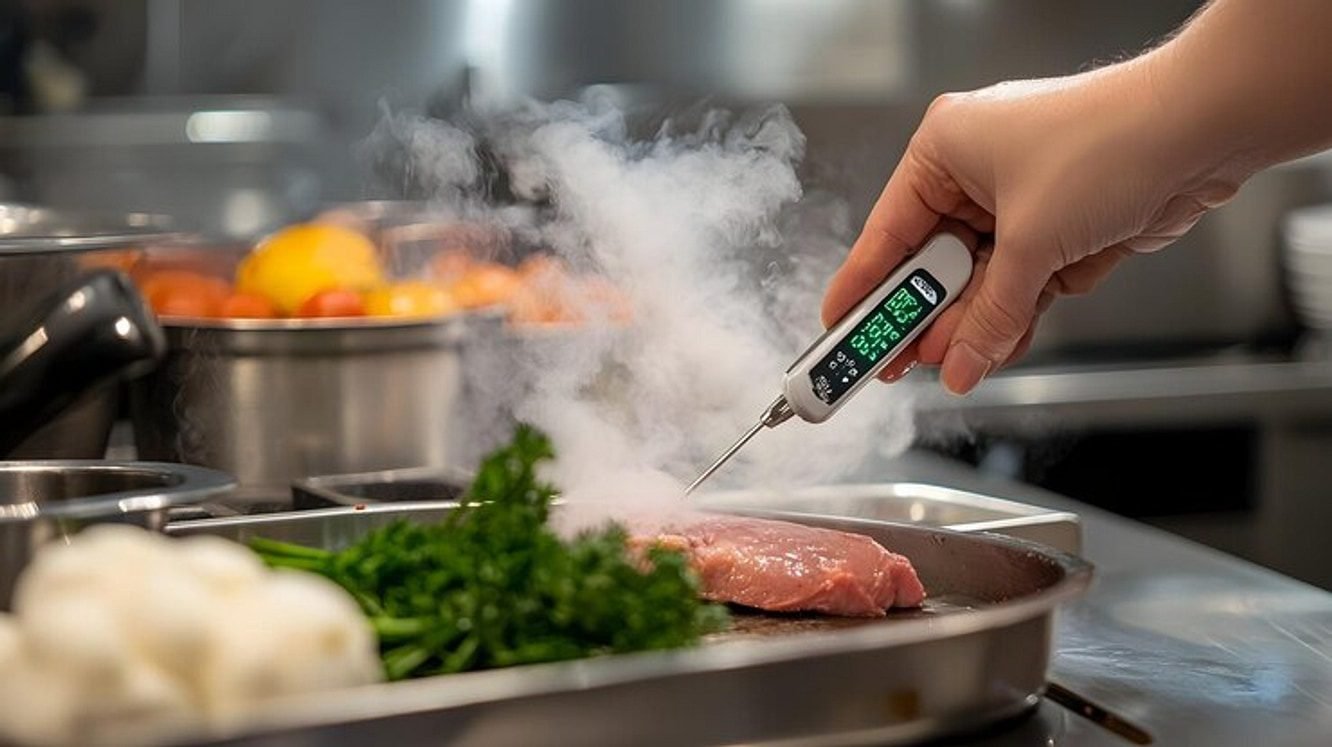
Food safety temperature doesn’t get much easier than this. Use our guide. We show you one of the best ways to guard your family against foodborne illness is to learn which temperatures are important, why they matter, and how to confidently use a thermometer every time you cook.
Food Safety Temperature Guide: Cooking, Cooling, and Reheating at Home
A browned surface or a bubbling sauce can tell you something about how food is cooking, but it cannot reliably tell you the temperature in the center. A food thermometer helps you check that directly.
This food safety temperature guide brings together the main temperatures home cooks need, along with practical advice on taking a reading, storing cooked food, and reheating leftovers. The recommendations below follow U.S. consumer guidance from USDA and FoodSafety.gov.
You do not need to memorize every number. Keep the temperature chart somewhere convenient, and check the category that matches what you are cooking.
Safe Minimum Internal Temperatures
The temperature inside the food is different from the temperature selected on your oven, grill, or air fryer. An oven set to 400°F does not mean the center of a chicken breast has reached its required cooking temperature.
Use a food thermometer to check the food itself.
| Food | Minimum internal temperature | Additional instruction |
|---|---|---|
| Chicken, turkey, and other poultry, including ground poultry | 165°F / 74°C | Check the thickest parts and more than one location when appropriate. |
| Ground beef, pork, veal, and lamb | 160°F / 71°C | Check the center of burgers and other ground-meat dishes. |
| Whole cuts of beef, pork, veal, and lamb: steaks, chops, and roasts | 145°F / 63°C | Allow at least 3 minutes of rest before cutting or eating. |
| Fish | 145°F / 63°C | Measure in the thickest part when possible. |
| Egg dishes, such as a plain frittata or quiche | 160°F / 71°C | Check the center; meat or poultry casseroles should reach 165°F / 74°C. |
| Casseroles and stuffing | 165°F / 74°C | Check the center and additional locations in larger dishes. |
| Reheated leftovers | 165°F / 74°C | Check several places for uneven heating. |
Source: FoodSafety.gov’s Safe Minimum Internal Temperature Chart.
Ground turkey and ground chicken belong in the poultry category. They should reach 165°F / 74°C, even when shaped into burgers or used in a dish where you would normally use ground beef.
These are general home-cooking recommendations. Commercial food-service rules and specialist cooking processes may use different time-and-temperature requirements.
How to Take a Useful Thermometer Reading
A thermometer only helps when its sensing area reaches the part of the food you need to measure.
For an instant-read thermometer:
- Check the manufacturer’s instructions. Different models have different sensing areas, insertion depths, and response times.
- Insert the probe into the thickest part. Avoid bone, large pockets of fat, and gristle.
- Keep the probe away from the cooking vessel. Contact with a hot pan or tray can distort the reading.
- Wait for the reading to stabilize. Do not assume every thermometer responds immediately.
- Check another spot when needed. Large, irregular, or mixed dishes can heat unevenly.
- Clean the probe after use and between checks involving raw or undercooked food. Follow the thermometer’s cleaning instructions.
For a thin burger or chicken cutlet, inserting the probe from the side can help position the sensing area in the center.
When cooking several pieces, check individual pieces rather than assuming they are all ready because one has reached the target. Differences in thickness and position in the pan can affect cooking.
The USDA’s food thermometer guide provides more detail on thermometer types and placement.
Understand What Your Thermometer Measures
An instant-read probe thermometer is useful for checking food near the end of cooking. A leave-in thermometer can monitor a roast as it cooks, provided the probe and cable are suitable for that appliance and temperature.
An infrared thermometer has a different purpose: it measures surface temperature. It can help assess a cooking surface, but it cannot establish the temperature inside a piece of meat.
Do not leave an instant-read thermometer in the oven unless its manufacturer specifically says it is suitable for that use. Check the instructions for cleaning and calibration, too.
Why the Three-Minute Rest Matters
For whole cuts of beef, pork, veal, and lamb, the recommended minimum of 145°F / 63°C comes with an additional requirement: at least three minutes of rest before carving or eating.
The temperature and rest time work together. Do not treat the rest as an optional serving suggestion.
Also, do not remove meat below its recommended minimum and assume that its temperature will rise enough afterward. The amount of carryover heating varies with the cut, size, cooking method, and surrounding conditions.
This rule does not mean that every food uses the same rest period. Follow the temperature and instructions for the relevant food category.
Keep Cooking Temperatures Separate From Storage Temperatures
Cooking and storage solve different problems. Reaching the recommended internal temperature does not mean a dish can then sit on the counter indefinitely.
For home food storage and serving, remember these reference points:
| Situation | Temperature or time |
|---|---|
| Refrigerator | 40°F / 4°C or below |
| Freezer | 0°F / −18°C or below |
| Keeping cooked food hot for serving | 140°F / 60°C or above |
| Perishable food without temperature control | Refrigerate within 2 hours |
| Perishable food when the surrounding temperature exceeds 90°F / 32°C | Refrigerate within 1 hour |
The two-hour and one-hour limits apply to time spent without appropriate temperature control, including preparation, transport, and serving.
At a gathering, put out smaller portions and replenish them from refrigerated or properly hot-held food. A serving dish that merely feels warm is not a dependable way to judge its temperature.
Cooling Cooked Food Without Leaving It Out for Hours
A common mistake is waiting for a large pot of food to reach room temperature before refrigerating it.
Instead, divide large quantities into smaller portions and shallow containers so they cool more quickly. A deep pot of soup loses heat much more slowly than several shallow portions.
Hot food can go directly into the refrigerator. An ice-water bath is another way to cool food rapidly before refrigeration. Either way, avoid leaving it on the counter for an extended period.
These cooling methods, along with the time limits above, are explained in the USDA’s guidance on leftovers and food safety.
Reheating Leftovers Evenly
Reheat leftovers to 165°F / 74°C. Check the center and other locations, particularly in dense foods or dishes with several ingredients.
Microwaves can leave cold spots, so stir or rotate food where possible. Use a microwave-safe container, cover it appropriately, and allow steam to escape.
Follow the appliance or package instructions for standing time, then check the temperature. If one area is still too cool, continue heating and check again.
Bring reheated soups, sauces, and gravies to a rolling boil. Stir them so heat is distributed throughout the mixture.
Avoid relying on a slow cooker to reheat cold leftovers. It may warm the food too gradually. Reheat using an appropriate method first; a suitable preheated appliance can then keep the food hot for serving.
A Good Temperature Reading Does Not Fix Every Problem
Cooking temperature is one part of safe food handling. It does not replace:
- Washing hands and cleaning utensils.
- Keeping raw meat and poultry separate from ready-to-eat food.
- Refrigerating perishable ingredients promptly.
- Thawing food safely.
- Following product storage instructions.
- Discarding food that has been held unsafely.
Do not use reheating as a rescue plan for food left out too long. Similarly, food that smells normal is not necessarily safe.
Plan storage before cooking a large batch. Have containers ready, make room in the refrigerator, and decide which portions you will use soon and which you will freeze.
Common Temperature Mistakes to Avoid
Using the oven setting as the food temperature.
The appliance temperature describes the cooking environment. Measure the center of the food separately.
Applying the ground-beef temperature to turkey burgers.
Ground poultry needs 165°F / 74°C.
Measuring against a bone or the pan.
Reposition the probe so the sensing area measures the food.
Checking only one piece in a crowded tray.
Thickness and placement can produce different results.
Judging meat only by color.
Browning, pinkness, or clear juices are not substitutes for a reliable internal-temperature reading.
Leaving cooked food out until completely cold.
Use smaller portions and prompt refrigeration instead of prolonged counter cooling.
Making Temperature Checks Part of Everyday Cooking
As someone who prefers straightforward recipes, I appreciate tools that make a kitchen decision easier. A thermometer gives you a number to work with when timing alone leaves you uncertain.
Keep it within reach, know which food category you are cooking, and check before serving. With a little practice, those steps become a normal part of preparing dinner.
You do not need to be an experienced cook to use this food safety temperature guide. Start with the dish in front of you, use the correct temperature, and give cooling and storage the same attention as cooking.
Sources and Scope
This guide summarizes U.S. consumer food-safety recommendations for home kitchens. Follow product labels and appliance instructions, and consult local guidance where requirements differ.