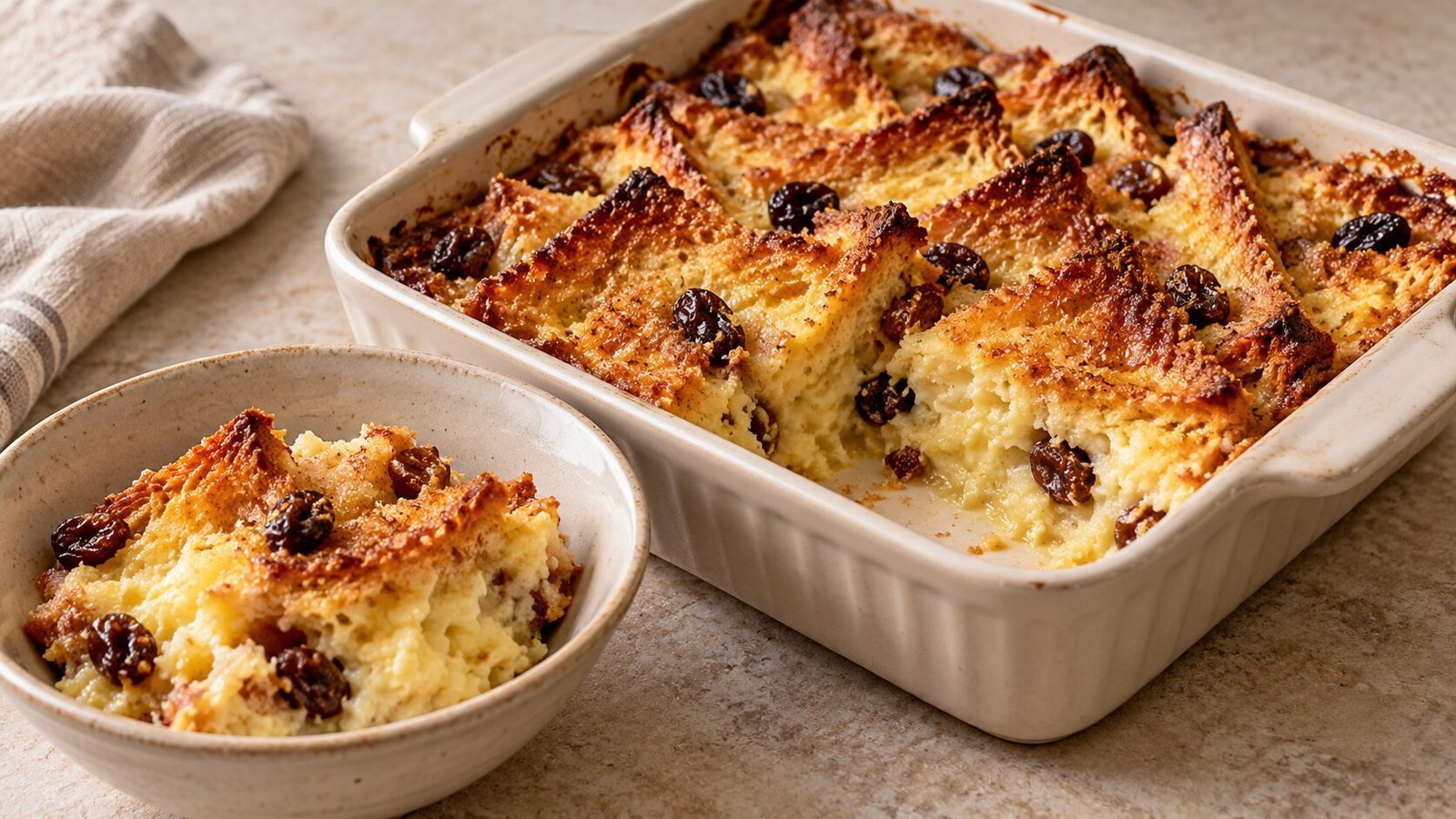
Bread and Butter Pudding Without Cream: An Easy Milk-Based Recipe
Bread and butter pudding turns a few everyday ingredients into a warm, comforting dessert. Buttered bread soaks up a mixture of milk, eggs, sugar, and vanilla, then bakes until the exposed edges are golden and the center is softly set.
This bread and butter pudding without cream uses semi-skimmed milk for the custard. Butter adds richness, while a small amount of raisins or sultanas brings sweetness between the layers.
The preparation is straightforward, but two details deserve attention: weighing the bread and allowing time for it to absorb the liquid. Those steps help you avoid dry patches on top and an unevenly soaked center.
What to Expect
This is a soft, spoonable dessert with lightly crisp bread edges. The inside should be moist and tender, with the egg-and-milk mixture set around the bread. It should not contain pools of uncooked custard.
You do not need to heat the milk or make a stovetop custard first. The eggs, milk, sugar, and vanilla are whisked together cold, poured over the bread, and cooked in the oven.
Although there is no cream, this recipe still contains milk and butter. It is not dairy-free.
Recipe at a Glance
- Servings: 4–6
- Preparation time: Approximately 15 minutes
- Soaking time: 15–20 minutes
- Baking time: Approximately 35–45 minutes
- Resting time: 10 minutes
- Total time: Approximately 1 hour 15 minutes to 1 hour 30 minutes
- Equipment: Shallow 1.5-litre baking dish, approximately 20 cm square, mixing bowl, whisk, and food thermometer
Times are estimates. Bread thickness, the baking dish, and your oven will affect the result.
Ingredients
- 200 g slightly stale white sandwich bread, approximately 6–8 slices
- 40 g softened unsalted butter, plus a little for greasing
- 40 g raisins or sultanas
- 3 large eggs
- 500 ml semi-skimmed milk
- 60 g granulated sugar, divided
- 1 teaspoon vanilla extract
- ¼ teaspoon ground cinnamon
- A small pinch of salt
Weigh the bread rather than relying on the slice count. Loaves vary considerably in size and thickness. Slices approximately 1 cm thick are a useful starting point.
How to Make Bread and Butter Pudding Without Cream
1. Prepare the dish and bread
Lightly grease the baking dish.
Spread the softened butter thinly over one side of each bread slice, using the full measured amount. Cut the slices into triangles or quarters.
You can leave the crusts on. Trim away particularly hard or thick edges if necessary, then weigh the bread after trimming.
2. Arrange the layers
Arrange about half the bread in the dish, buttered sides facing upward. Scatter most of the raisins or sultanas between the slices.
Add the remaining bread in a slightly overlapping layer. Tuck the remaining dried fruit into the gaps rather than leaving it exposed on top, where it can scorch.
Keep the layers fairly loose so the milk mixture can reach the lower pieces.
3. Mix the custard
Crack the eggs into a bowl and whisk until the whites and yolks are thoroughly combined.
Add the milk, 50 g of the sugar, vanilla, cinnamon, and salt. Whisk again until evenly mixed. Reserve the remaining 10 g sugar for the top.
There is no need to whip the mixture into a foam.
4. Pour and soak
Slowly pour the custard over the bread, aiming across the whole dish rather than into one spot.
Press the bread down gently with the back of a spoon so that the upper pieces come into contact with the liquid. Let it soak for 15–20 minutes, pressing lightly once more halfway through.
The bread should soften and absorb some of the mixture, although liquid will still be visible around it. Very dry bread may need a little longer to soften.
While it soaks, preheat the oven to 350°F (180°C), or 320°F (160°C) fan.
5. Bake until softly set
Sprinkle the reserved sugar over the surface. Place the dish on the middle oven shelf.
Bake for approximately 35–45 minutes, beginning to check after 30 minutes. The exposed bread edges should be golden, and the center should be softly set.
A slight wobble is fine, but the middle should not ripple like liquid when the dish is moved gently. Check that the center reaches at least 160°F (71°C) with a food thermometer, without touching the bottom of the dish.
If the top browns before the center is ready, loosely cover with foil and continue baking. Use both the temperature and the texture to judge doneness.
6. Rest before serving
Remove from the oven and let the pudding stand for approximately 10 minutes. This gives the interior time to settle and makes serving easier.
Spoon into bowls and serve warm. It is satisfying on its own, or you can add a little fresh fruit alongside.
Choosing the Bread
Plain white sandwich bread provides a straightforward starting point because its texture and sweetness are relatively consistent.
Slightly stale bread is useful here, but it should still be sound and free from mold. Very hard, thick bread needs more attention during soaking; do not assume the same timing will soften every type of loaf.
Brioche can be used as a variation, although it contains more richness and sweetness of its own. It will change the character of the pudding, so begin with the plain white bread version if you want to follow the recipe closely.
Troubleshooting
The top is browning too quickly.
Cover loosely with foil and continue cooking until the center is ready. Moving the dish higher in the oven will not help an undercooked middle.
Some bread pieces are dry.
Check that the upper slices touch the custard during soaking. A few crisp tips are part of the dish, but large dry areas suggest that the bread was insufficiently soaked or too tightly packed.
The center is still liquid.
Continue baking, checking at short intervals. A deep dish or a cool starting mixture can extend the cooking time.
The pudding is firmer than expected.
Check the bread weight and baking time next time. Too much bread or prolonged baking can produce a drier result. Remove it once the custard is set and the safe temperature has been reached.
Storing and Reheating
Refrigerate leftovers in a covered container within two hours of cooking. Use within 3–4 days.
Reheat individual portions, loosely covered, until the center reaches 165°F (74°C). A small splash of milk can help moisten the bread, although the crisp edges will soften during storage and reheating.
Allergens: Contains wheat, eggs, and milk. Check the bread and other packaged ingredients for additional allergens.
A Final Note from Adam
I appreciate recipes that give everyday ingredients another purpose. As someone who is still learning in the kitchen, I also like having clear signs to look for: softened bread before baking, a golden top, and a center that has properly set.
If your bread triangles sit unevenly or your first serving does not lift out neatly, that is perfectly fine. This is a dessert to spoon into a bowl and enjoy warm. Take your time with the soaking stage, check the middle carefully, and let the finished pudding rest before serving.
Recipe and image note: This recipe was developed with AI assistance and has not been independently kitchen-tested for this article. Cooking times and yields are estimates. Any images identified as AI-generated are illustrations and do not document a cooked or tested result.
Food Safety Sources
For guidance on cooking egg-containing dishes, see the FDA’s What You Need to Know About Egg Safety.
For refrigeration and reheating advice, consult the USDA’s Leftovers and Food Safety.
These resources support the food safety guidance; they do not represent testing or endorsement of this recipe.