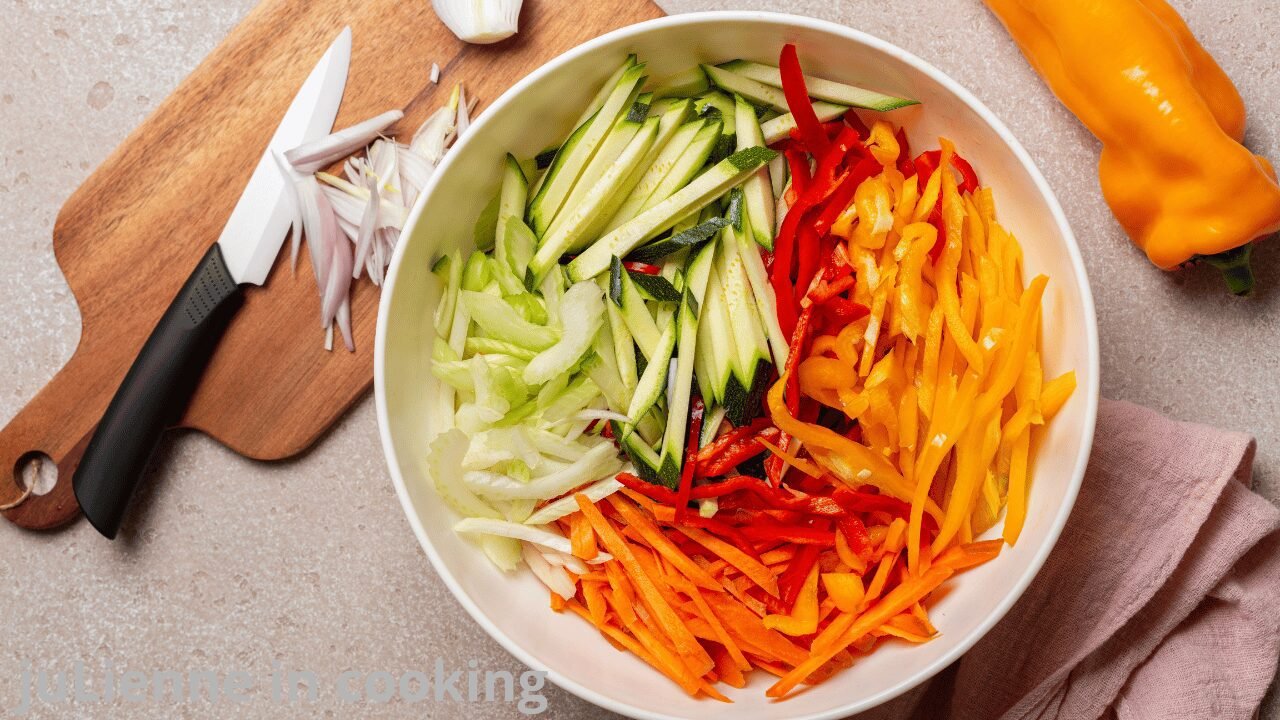
In cooking, julienne means to cut an ingredient into thin, evenly sized, matchstick-shaped strips. You will often see this instruction for carrots, cucumber, zucchini, or other vegetables used in salads, garnishes, and stir-fries.
A common culinary reference size is approximately ⅛ inch thick, ⅛ inch wide, and 2 inches long—about 3 × 3 × 50 mm. For home cooking, reasonably consistent strips are usually more important than exact measurements. Follow any dimensions specified in your recipe. Rouxbe Online Culinary School
The technique may sound formal, but the basic sequence is straightforward: cut the ingredient into thin slices, then cut those slices into narrow strips.
Why Use a Julienne Cut?
Thin strips change how a vegetable feels in a dish. Julienned carrot gives a salad a lighter bite than thick rounds, while cucumber strips can fit neatly inside a wrap or summer roll.
The cut also helps you prepare similarly sized pieces of the same ingredient. This makes their cooking more consistent than a mixture of thick chunks and very thin slivers.
However, identical dimensions do not make different vegetables cook at the same speed. Carrot and zucchini strips may still need to enter the pan at different times.
Julienne, Batonnet, and Brunoise: What Is the Difference?
| Term | Shape | Main distinction |
|---|---|---|
| Julienne | Thin, matchstick-like strips | Narrow sticks rather than cubes |
| Batonnet | Thicker sticks | More substantial than julienne |
| Brunoise | Very small cubes | Commonly made by cutting across julienne strips |
| Grated or shredded | Small shreds of varying shape | Produced by a grater or shredding attachment |
These cuts are related, but they are not interchangeable in every recipe. A grated carrot has a different texture from a neatly julienned carrot.
For a standard brunoise, cutting across ⅛-inch julienne strips at matching intervals produces approximately ⅛-inch cubes. Rouxbe Online Culinary School
How to Julienne a Carrot with a Knife
A carrot is a useful ingredient for learning because its firm structure holds its shape while you work.
1. Prepare the carrot
Wash the carrot, trim the ends, and peel it if the recipe calls for peeling. Cut it into manageable lengths, approximately 2 inches long for a conventional julienne.
Set your cutting board on a stable surface. Use a nonslip mat or a damp cloth underneath if the board moves.
2. Make a stable base
Carefully remove a thin slice from one side of a carrot section. Place the newly flattened surface against the board so the carrot cannot roll easily.
For everyday cooking, you do not need to carve away every curved edge. A stable base is the priority.
3. Cut thin, even slices
Cut lengthwise into slices approximately ⅛ inch thick.
Keep the fingertips of your guiding hand curled inward, with your thumb tucked away from the blade. Work at a pace that lets you control each cut.
4. Cut the slices into strips
Lay a slice flat and cut it lengthwise into strips approximately as wide as the slice is thick.
If you feel comfortable, stack a few stable slices before cutting. If they slide or tilt, return to one slice at a time.
5. Check the thickness
Compare your first few strips. If some are much thicker than others, adjust before continuing.
Matching the slice thickness and strip width is what creates the recognizable matchstick shape. This slice-then-strip method is the foundation of knife-cut julienne. bbcgoodfood.com
Adapting the Technique to Other Vegetables
Cucumber: Cut manageable sections into slices and then strips. If the recipe needs firm, relatively dry pieces, remove the soft seed center first. Otherwise, follow the recipe’s preparation instructions.
Zucchini: The outer flesh makes firmer strips than a large, seedy center. Cut gently to avoid crushing it, and remember that thin zucchini cooks quickly.
Bell pepper: Remove the stem, seeds, and inner ribs. Divide the walls into flatter panels, then slice them narrowly. Because the pepper has a natural thickness, the strips may not match a classical julienne exactly.
Ginger: Cut the prepared ginger into thin slices, then narrow strips. These are often finer than a standard vegetable julienne, so use the recipe’s intended texture as your guide. Good Food demonstrates this approach in its ginger preparation guide. bbcgoodfood.com
Can You Use a Julienne Peeler or Mandoline?
Yes. A julienne peeler or a mandoline with a suitable attachment can make thin vegetable strips. The result depends on the tool’s blade spacing and settings, so it may differ from the dimensions of a knife-cut julienne.
A plain slicing blade makes slices, not finished matchsticks. Some mandolines have a separate julienne blade or setting.
Follow your model’s instructions and use its food holder or hand guard. Do not push the final small piece across the blade with bare fingers. Stop when the remaining piece can no longer be held securely.
OXO’s mandoline instructions, for example, show a specific blade arrangement and food holder for julienning. That setup should not be assumed to apply to every slicer. oxo.com
Common Problems and Simple Adjustments
| Problem | What to change |
|---|---|
| The vegetable rolls | Create a flat resting surface before continuing. |
| Strips are wide and flat | Cut narrower strips, matching the thickness of the slices. |
| Some strips are much thicker | Make the initial slices more consistent. |
| Stacked slices slip | Reduce the stack or cut one slice at a time. |
| Vegetables become too soft during cooking | Check them earlier; thin strips need different timing from chunks. |
You do not need to discard every uneven edge. Suitable trimmings can go into another preparation where their shape matters less.
A Skill Worth Practicing Slowly
Start with one carrot and aim for a small handful of reasonably even strips. There is no need to match the speed of a cooking demonstration.
Once you understand the sequence, julienning becomes much less mysterious. A stable vegetable, consistent slices, and controlled cuts will do more for your results than rushing toward perfectly shaped matchsticks.