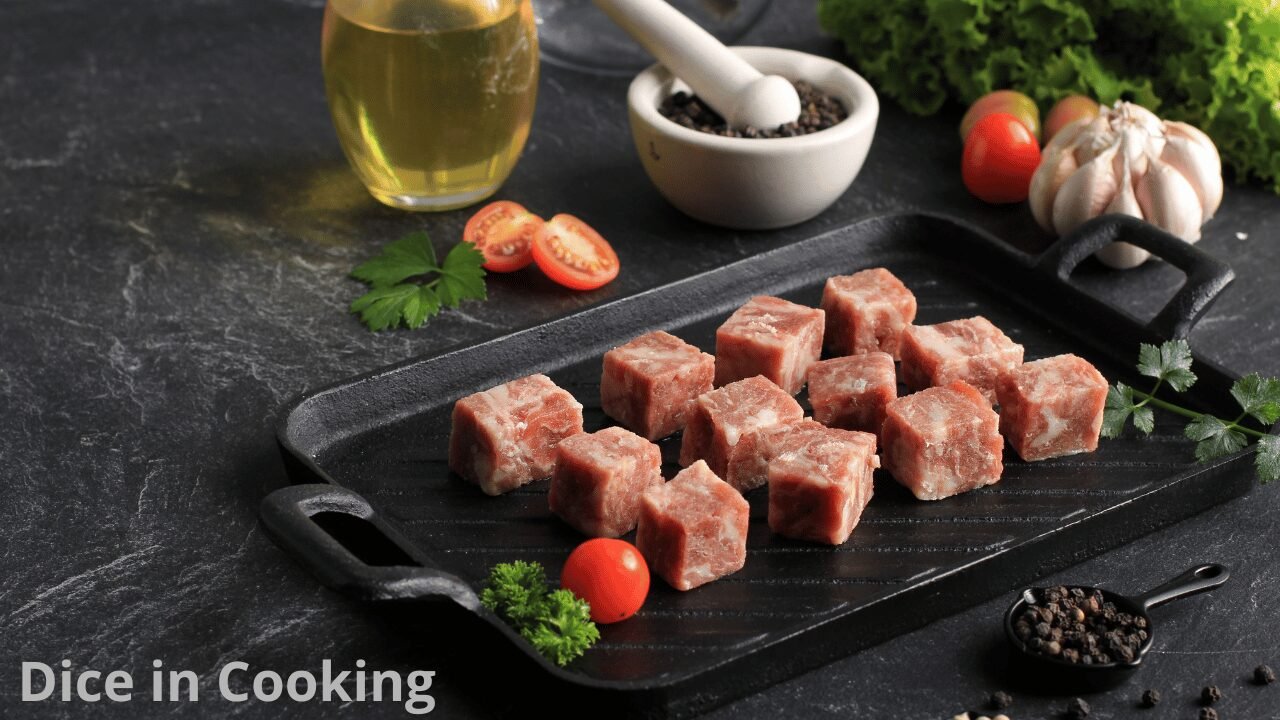
In cooking, dice means to cut food into small, roughly uniform cubes. A recipe might ask you to dice potatoes for soup, cucumber for a salad, or an onion for a sauce.
The aim is to produce pieces with similar length, width, and thickness. They do not need to look perfectly geometric, especially when you are cooking at home.
Unlike a rough chop, dicing pays more attention to shape and consistency. Similar-sized pieces of the same ingredient generally cook more evenly and give the finished dish a more consistent texture. Escoffier
How Big Should Diced Pieces Be?
Recipes sometimes specify a small, medium, or large dice. These are common culinary reference sizes:
| Cut | Approximate size on each side | Possible uses |
|---|---|---|
| Small dice | ¼ inch / 6 mm | Vegetables for fillings, sauces, or finely textured salads |
| Medium dice | ½ inch / 12–13 mm | Potatoes and vegetables for soups or side dishes |
| Large dice | ¾ inch / about 2 cm | Chunkier vegetable dishes and some stews |
These measurements are useful guides, not a reason to measure every piece. If a recipe gives a specific size, follow that instruction even if its terminology differs from the table. resources.escoffier.edu
When a recipe simply says “diced,” consider the dish. A spoonful of salsa usually needs smaller pieces than a chunky vegetable stew. Recipe photographs and cooking times can provide additional clues.
Diced, Chopped, Minced, and Julienned: The Difference
These terms describe different results:
- Diced: roughly uniform cubes.
- Chopped: pieces that may be less regular in shape; size depends on the instruction.
- Minced: very fine pieces, usually smaller than an ordinary dice.
- Julienned: thin, matchstick-shaped strips.
Julienne and batonnet are stick-shaped cuts, rather than types of dice. Cutting across those sticks can produce cubes, which is why the techniques are related. Escoffier
How to Dice a Firm Vegetable
A potato is a useful example because it demonstrates the basic sequence: slices, sticks, then cubes.
1. Prepare the vegetable and cutting board
Wash the vegetable and remove any unwanted parts. Peel it if the recipe calls for peeling; dicing itself does not require removing every edible skin.
Place your board on a stable surface. If it slides, use a suitable nonslip mat or a damp cloth underneath it.
Choose a sharp kitchen knife that you can control comfortably.
2. Create a flat resting surface
Round vegetables can roll. Carefully remove a thin slice from one side, then place that flat surface against the board.
You do not need to trim the entire vegetable into a perfect rectangular block. For everyday cooking, a stable base and reasonably even pieces are sufficient.
3. Cut into even slices
Slice the vegetable to the thickness of your intended cubes.
For example, a medium dice starts with slices approximately ½ inch thick. Keep your guiding fingertips curled inward and your thumb tucked away from the blade.
4. Cut the slices into sticks
Lay a slice flat and cut it into strips of the same width as its thickness.
Work with one slice at a time if stacking them feels unstable. Speed is less important than keeping the food under control.
5. Cut across the sticks
Turn the sticks and cut across them at the same interval. Matching the slice thickness, strip width, and final cut spacing produces cubes.
Check the first few pieces before continuing. Adjusting early is easier than discovering that half the vegetable has been cut much smaller than the rest. The slice-to-stick-to-cube sequence is a standard approach to dicing. bbcgoodfood.com
Does the Same Method Work for Every Ingredient?
The basic idea carries across, but the ingredient’s structure affects how you handle it.
Bell peppers: Remove the stem, core, and seeds. Cut the walls into manageable panels, then into strips and crosswise pieces. Their natural thickness means the finished pieces will not be perfect cubes.
Cucumbers: Cut a stable section into slices, strips, and then cubes. Remove the watery seed center only if the recipe calls for it or the desired texture requires it.
Onions: Their layers naturally divide some of the pieces. Use a method designed for halved onions rather than trying to balance a whole onion while making cuts.
Soft tomatoes: Use a sharp knife and gentle pressure. Crushing the flesh makes neat pieces difficult, regardless of how carefully you space the cuts.
Why Consistent Size Matters
A pan containing tiny potato pieces and large chunks can finish unevenly: the small pieces may soften or break apart while the larger ones remain firm.
Consistency helps, but it does not make different ingredients cook at identical speeds. Equal-sized carrot and zucchini cubes may still need different cooking times.
The practical goal is to control one variable—the size of each ingredient—while following the recipe’s order for adding them.
Common Dicing Problems
| Problem | Helpful adjustment |
|---|---|
| The vegetable rolls | Create a flat surface before continuing. |
| Cubes vary greatly in size | Check the thickness of the initial slices. |
| Stacked slices slip | Work with fewer slices or one at a time. |
| Soft ingredients become crushed | Use a sharp blade and reduce downward pressure. |
| Preparation feels slow | Practice an even rhythm without trying to match professional speed. |
Avoid using a standard food processor chopping blade when you need neat cubes. It produces chopped pieces rather than a controlled dice; a machine needs an appropriate dicing attachment for that task.
Start with Consistency, Not Perfection
A few rounded edges will not spoil dinner. For most home cooking, pieces that are close in size are more useful than perfectly squared cubes that create unnecessary trimmings.
Choose one vegetable, work slowly, and check your first few cuts. With practice, the sequence becomes familiar, and “dice the vegetables” starts to feel like a clear instruction rather than an extra challenge.