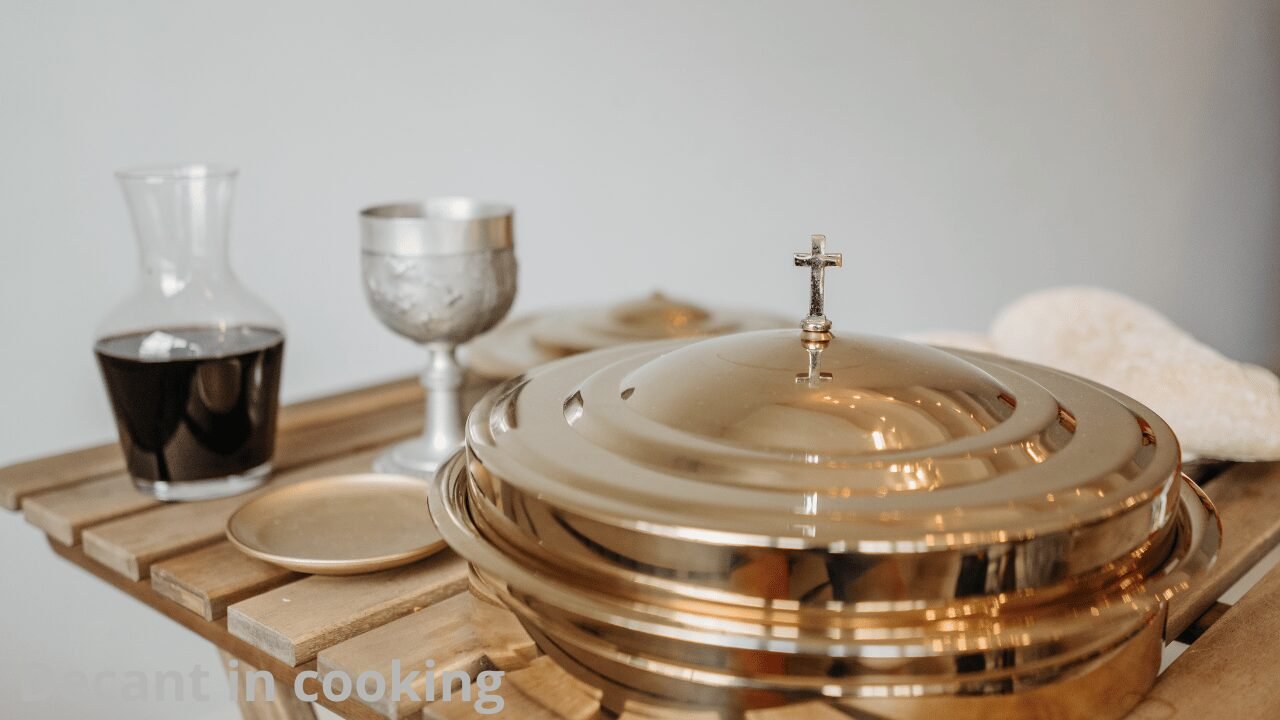
In cooking, decant means to carefully pour a liquid from one container into another, often leaving sediment behind. You may also see the word used more generally when transferring a liquid into a serving or storage container.
The important detail is the purpose of the instruction. If a recipe tells you to decant a liquid without disturbing the sediment, you should leave the settled material in the original vessel. If it simply says to decant a finished sauce into a jug, it may only mean to transfer it for serving.
Decanting does not automatically involve a sieve, and it is not another name for every kind of liquid separation. definition in the Cambridge English Dictionary
Decanting, Straining, Draining, and Skimming
These instructions describe different actions, even though several involve separating a liquid from something else.
| Instruction | What you do | Kitchen example |
|---|---|---|
| Decant | Carefully pour liquid into another vessel, potentially leaving settled material behind | Pour wine away from sediment |
| Strain | Pass a mixture through a sieve or filter | Remove herbs from an infused liquid |
| Drain | Remove unwanted liquid from food | Drain cooked pasta in a colander |
| Skim | Lift material from the surface | Remove floating fat with a spoon |
The distinction helps you choose the right equipment. Pouring a herb infusion into another jug will not reliably remove floating leaves. A strainer is more appropriate.
Similarly, transferring broth between bowls does not necessarily remove the fat. If fat is floating on the surface, skimming or using a fat separator is a more targeted approach.
How to Decant a Liquid Away from Sediment
When the aim is to leave a deposit behind, the basic technique is a slow, controlled pour.
1. Check that the sediment has settled
Decanting works best when the material you want to leave behind forms a distinct deposit. Shaking or stirring the container just before pouring mixes it back into the liquid.
If particles remain suspended throughout, decanting alone may not produce the clarity you want.
2. Prepare a suitable receiving container
Choose a clean vessel with enough capacity and an opening that makes pouring manageable.
For hot liquids, use a heat-safe container. A decorative wine decanter is not automatically suitable for hot stock or sauce.
3. Pour slowly and steadily
Tilt the original container gently. Watch the liquid as it approaches the opening, and avoid sudden movements that disturb the deposit.
Good lighting makes it easier to notice particles moving toward the stream.
4. Stop before the sediment follows
Leave the final small amount behind if it contains the material you are trying to exclude. Trying to recover every last drop can undo the separation.
This is particularly useful when decanting wine with a deposit: the goal is a clear pour, rather than an entirely empty bottle. The Wine Society recommends standing such bottles upright beforehand and stopping when sediment reaches the bottle’s shoulder. FAQs
Why Is Wine Decanted?
Wine is commonly decanted for two separate reasons: to separate it from sediment and to expose it to air.
Some aged reds, vintage ports, and minimally filtered wines develop deposits. These deposits are not necessarily a sign that the wine has spoiled, but they can make the last glass gritty or less pleasant to drink.
Aeration has a different purpose. Exposure to air can change how a wine’s aromas and flavors are perceived. However, that does not mean every wine improves after spending time in a decanter.
Many everyday wines contain little sediment and can be served directly from the bottle. WSET
Do older wines always need more air?
No. An older wine may need careful pouring to remove sediment while benefiting from little additional air exposure.
Some mature wines are delicate and can lose appealing characteristics after prolonged aeration. Separating a wine from its deposit and leaving it to breathe for hours are different decisions. Christie’s
Can white wine be decanted?
Yes, although it is not necessary for most everyday white wines. Some styles may benefit from aeration.
Serving a white wine chilled does not, by itself, determine whether decanting is useful. Follow guidance for the particular bottle rather than a blanket rule based on its color. WSET
Do You Need a Special Decanter?
For an ordinary kitchen transfer, usually not. A suitable jug or other food-safe container may be enough.
A wine decanter can make wine service more convenient, but the container should suit the task. A wide vessel encourages greater air exposure; that is not necessarily what you want when carefully separating a delicate older wine from sediment.
For sauces and other kitchen liquids, prioritize a stable base, a manageable opening, sufficient capacity, and appropriate heat resistance.
What Decanting Cannot Do
Decanting is a physical transfer or separation step. It does not:
- Remove dissolved salt or sugar.
- Reliably separate an emulsified sauce into its original ingredients.
- Replace filtering when fine particles remain suspended.
- Make spoiled food or drink suitable to consume.
It also does not guarantee a better flavor. Whether the transfer helps depends on what you are trying to achieve.
Reading the Instruction with Confidence
When you encounter “decant” in a recipe, look at the words around it. “Decant into a serving jug” describes a transfer; “decant, leaving the sediment behind” asks for a careful separation.
Once that purpose is clear, the action is straightforward. Choose a suitable container, pour with control, and stop when you have achieved the result the recipe needs.